


 New Cars
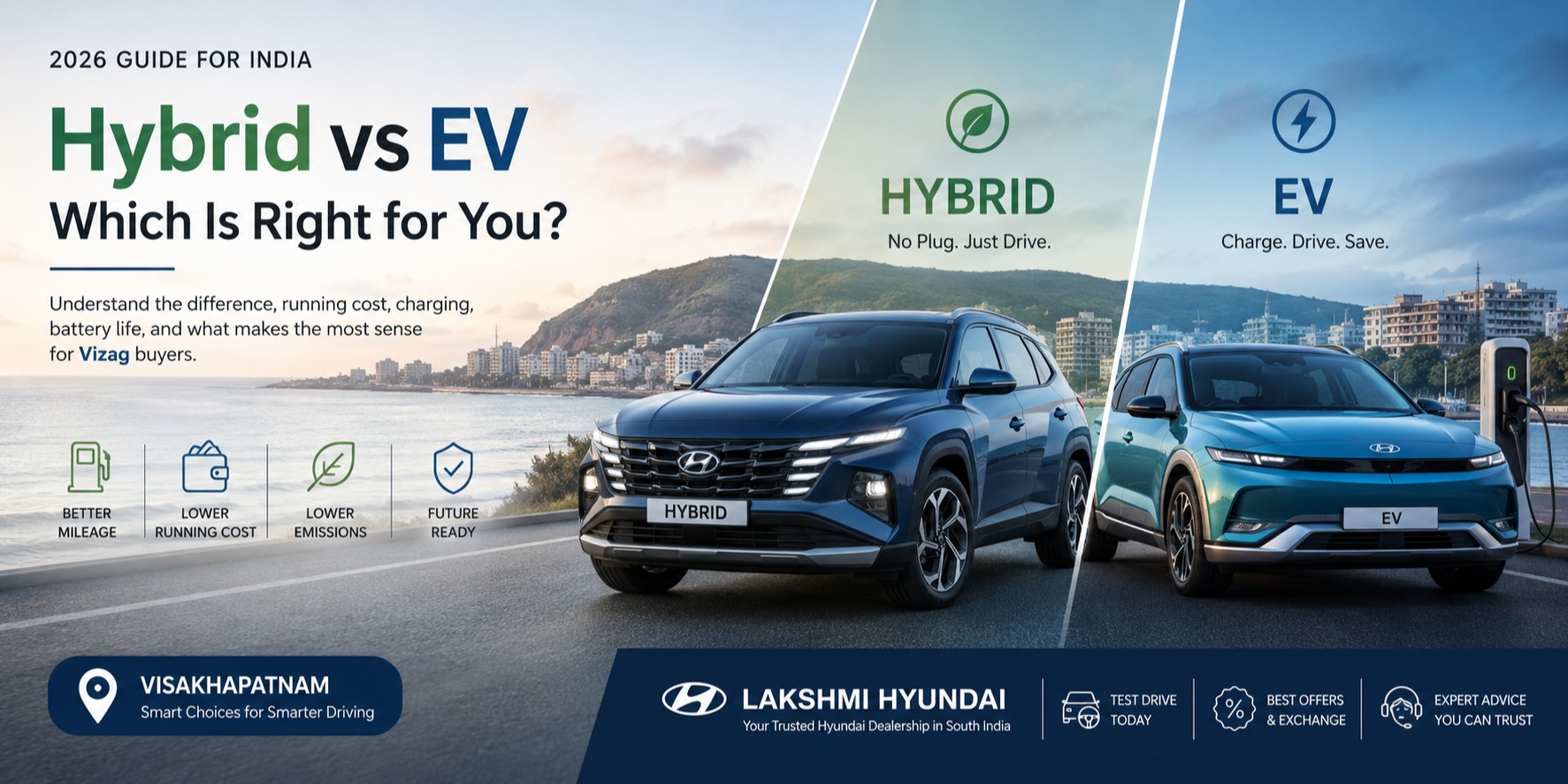
What Is a Hybrid Car? Hybrid vs EV Guide for India 2026
Confused about what is a hybrid car versus an EV? Learn how they work, charging, battery life, and which suits India. Visit Lakshmi Hyundai, Vizag today.
Introduction
Picture yourself stuck in Visakhapatnam's morning traffic on NH-16, fuel needle dropping while the bill climbs past INR 100 a litre. Now picture the same drive in a car that switches to silent electric power the moment you slow down, sipping almost no fuel at all. That is the promise behind the question on every smart buyer's mind: what is a hybrid car, and is it the right choice over a fully electric vehicle?
This guide answers exactly that. Over the next sections we will explain how hybrids and EVs actually work, what charging and battery life look like in real Indian conditions, how much they cost to run, and whether an EV makes sense for a coastal city like Vizag. By the end, you will know which technology fits your driving life.
Quick Answer Summary
A hybrid car combines a petrol engine with a battery-powered electric motor, so it never needs plugging in and refuels at any petrol pump, while an EV (electric vehicle) runs purely on a battery that you charge from electricity. For most Indian buyers in 2026, a hybrid is the easier first step because of fewer charging worries, while an EV offers the lowest running cost if you have home charging.
Key Takeaways
A hybrid car is a vehicle that uses both a petrol engine and an electric motor, automatically switching between them to save fuel - no plugging in required.
An EV is a vehicle powered only by a rechargeable battery and electric motor, with zero tailpipe emissions.
The core difference between hybrid and EV is the fuel source: hybrids still burn petrol; EVs use only electricity.
Hybrids deliver 20–40% better mileage than regular petrol cars without any charging infrastructure.
EVs cost roughly 1–1.5 per km to run versus 6–8 per km for petrol - a major long-term saving.
For Vizag buyers, public charging is growing but still limited, making hybrids the lower-risk option for now.
What Is a Hybrid Car and How Does It Work?
A hybrid car is a vehicle that pairs a conventional petrol engine with one or more electric motors and a small battery, allowing it to run on electricity, petrol, or both depending on the situation. You never plug it in - the battery recharges itself through the engine and through braking.
Here is how it works in practice:
At low speeds or in traffic, the electric motor moves the car silently, using no petrol.
During acceleration or highway cruising, the petrol engine takes over or works alongside the motor.
When you brake, a system called regenerative braking captures energy that is normally lost as heat and feeds it back into the battery.
When the battery runs low, the petrol engine recharges it automatically.
At a stop, the engine can switch off entirely to save fuel.
What Is an EV and How Is It Different?
An electric vehicle (EV) is a car powered entirely by a battery pack and electric motor, with no petrol engine at all. You charge it from a wall socket, a home charger, or a public charging station, much like charging a phone.
The key difference between a hybrid and an EV comes down to a few core factors. A hybrid car draws its power from both a petrol engine and an electric motor, while an EV runs on a battery alone. Because of this, a hybrid never needs charging - it recharges itself as you drive - whereas an EV must be plugged into electricity. That difference shows up at the tailpipe too: hybrids produce lower emissions than a regular petrol car, but an EV produces none at all. On running cost, a hybrid works out to roughly INR 3–4 per km against just INR 1–1.5 per km for an EV, though the EV's lower running cost comes with a higher upfront price (one that is steadily falling). The trade-off is convenience versus cost: a hybrid carries no range anxiety since it refuels at any pump, while an EV's everyday practicality depends on how easily you can charge it. In short, a hybrid is the bridge between a petrol car and a full EV - and an EV is the destination.
How Do You Charge and Maintain These Cars?
This is where the two technologies differ the most, especially for a city like Visakhapatnam.
Charging an EV in India
Home charging (the most common): A standard EV takes 6–8 hours on a home AC charger for a full charge - ideal overnight.
Fast charging (DC): Public fast chargers can deliver 0–80% in 30–60 minutes.
Public networks: India crossed over 25,000 public EV charging stations by early 2026, with Andhra Pradesh expanding stations across Visakhapatnam, Vijayawada, and along NH-16.
A growing number of EV charging stations in Visakhapatnam now appear at malls, fuel stations, and tech parks, though coverage is still thinner than in metros like Bengaluru or Delhi.
Charging a Hybrid
There is nothing to charge. A hybrid refuels at any petrol pump in seconds, which is why it remains the practical choice for buyers without dedicated home charging.
Battery Life
Modern EV and hybrid batteries are built to last. Most manufacturers, including Hyundai, offer battery warranties of 8 years or around 1,60,000 km. Based on current industry data, batteries typically retain 70–80% of their capacity even after 8 years of normal use, making long-term ownership far less risky than many buyers fear.
Is EV Good for India? An Honest Assessment
Is EV good for India? The honest answer is: increasingly yes, but with conditions. EVs make excellent sense if you have access to home or workplace charging and mostly drive within and around the city. They struggle if you frequently take long intercity trips through areas with sparse charging.
For Vizag specifically, consider these local factors:
Coastal salt air affects all cars; EVs and hybrids handle it the same as petrol cars with proper care.
Charging growth is real but still concentrated near the city centre and highways.
Electricity cost in Andhra Pradesh keeps EV running costs very low compared to 100+ petrol.
Government incentives under FAME and state EV policies continue to reduce on-road EV prices in 2026.
For most Vizag families buying their first low-emission car, a full hybrid offers the smoothest transition. For tech-park commuters with home charging, an EV is genuinely cheaper to live with.
Common Mistakes to Avoid
Assuming all hybrids plug in - only plug-in hybrids (PHEVs) do; full and mild hybrids never need charging.
Buying an EV without checking home charging - without a home charger, ownership becomes far less convenient.
Ignoring the battery warranty -always confirm the 8-year coverage and what it includes before buying.
Comparing only the sticker price - factor in fuel savings; an EV's higher price often pays back within a few years.
Skipping a test drive - the silent, instant-torque feel of a hybrid or EV is very different from a petrol car.
Forgetting service access - buy from a dealership equipped to service hybrid and electric systems, not just any garage.
Frequently Asked Questions
Q: What is a hybrid car in simple words?
A: A hybrid car is a vehicle that uses both a petrol engine and an electric motor together. It automatically switches between them to save fuel and never needs to be plugged in, because the battery recharges itself.
Q: What is the main difference between hybrid and EV?
A: The main difference is the fuel source. A hybrid still uses petrol alongside an electric motor, while an EV runs only on a battery that you charge from electricity. EVs produce zero tailpipe emissions; hybrids reduce but do not eliminate them.
Q: Is EV good for India in 2026?
A: Yes, especially for city drivers with access to home or office charging, thanks to very low running costs and growing public infrastructure. However, hybrids remain better for those who take frequent long trips or lack convenient charging.
Q: How long does an EV or hybrid battery last?
A: Most EV and hybrid batteries last 8 years or around 1,60,000 km, covered by warranty. They typically keep 70–80% of their capacity even after this period under normal use.
Q: Are there EV charging stations in Visakhapatnam?
A: Yes. Visakhapatnam has a growing network of public EV charging stations at malls, fuel outlets, and tech parks, with Andhra Pradesh actively expanding coverage along NH-16 and within the city.
Q: Which is cheaper to run, a hybrid or an EV?
A: An EV is cheaper to run at roughly INR1–1.5 per km, compared to 3–4 per km for a hybrid and 6–8 per km for a petrol car. The trade-off is the EV's higher purchase price.
Q: Do hybrid cars need charging?
A: No, full and mild hybrids never need charging — they recharge themselves through the engine and braking. Only plug-in hybrids (PHEVs) can be charged from a socket for extra electric range.
Visit Lakshmi Hyundai, Vizag - Your Trusted Hyundai Dealership in South India
Choosing between a hybrid and an EV is far easier when you can sit in both and feel the difference. As a trusted Hyundai dealership in South India, Lakshmi Hyundai in Visakhapatnam offers test drives, transparent on-road pricing, and a service team trained on Hyundai's hybrid and electric systems.
Our advisors can walk you through current government incentives, finance and EMI options, exchange offers on your old car, and the best Hyundai model for your daily Vizag driving. Whether you want the no-charging convenience of a hybrid or the low running cost of an EV, our experts can build the right recommendation around your budget and routine.
Visit Lakshmi Hyundai in Visakhapatnam or book your test drive today - and take the first confident step toward smarter, cleaner driving.
- Introduction
- Quick Answer Summary
- Key Takeaways
- What Is a Hybrid Car and How Does It Work?
- What Is an EV and How Is It Different?
- How Do You Charge and Maintain These Cars?
- Charging an EV in India
- Charging a Hybrid
- Battery Life
- Is EV Good for India? An Honest Assessment
- Common Mistakes to Avoid
- Frequently Asked Questions
- Q: What is a hybrid car in simple words?
- Q: What is the main difference between hybrid and EV?
- Q: Is EV good for India in 2026?
- Q: How long does an EV or hybrid battery last?
- Q: Are there EV charging stations in Visakhapatnam?
- Q: Which is cheaper to run, a hybrid or an EV?
- Q: Do hybrid cars need charging?
- Visit Lakshmi Hyundai, Vizag - Your Trusted Hyundai Dealership in South India

16 June 2026